2分钟阅读
CS61B 学习笔记 - Heap & MinPQ
1. Interface
以下是最小优先队列所需实现的方法。在这个数据结构中,我们只关心其最小值。
/** (Min) Priority Queue: Allowing tracking and removal of
  * the smallest item in a priority queue. */
public interface MinPQ<Item> {
    /** Adds the item to the priority queue. */
    public void add(Item x);
    /** Returns the smallest item in the priority queue. */
    public Item getSmallest();
    /** Removes the smallest item from the priority queue. */
    public Item removeSmallest();
    /** Returns the size of the priority queue. */
    public int size();
}
2. MinPQ
我们使用二叉树来实现这个数据结构,但是,它还需要满足以下两个性质:
每个节点都小于或等于它的两个子节点
只允许树的最底部有空缺,其他层必须是完整的,且所有节点尽可能靠左
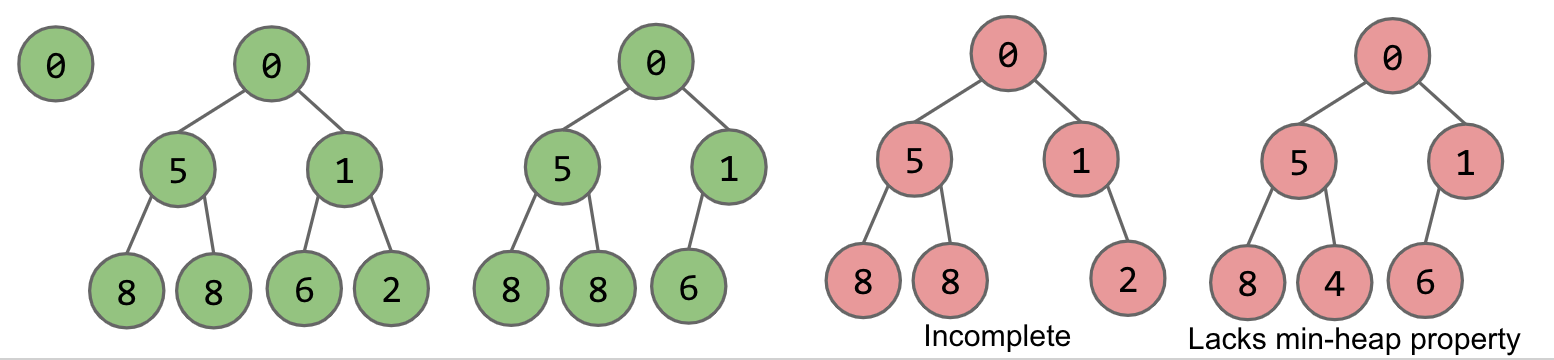
在上图中,绿色表示有效的堆,红色则不是
我们同样使用数组来表示这样一棵树。但与 BST 不同,根节点存储在 pq[1] 中,而不是 pq[0];对于树上的节点 K,它的子节点,父节点位于:
leftChild(k) = 2 * k
rightChild(k) = 2 * k + 1
parent(k) = k / 2
比如根节点(k = 1) 的左节点存储在 pq[2],右节点存储在 pq[3],其左右节点的父节点(也就是根节点自身)存储在 pq[1](2 / 2 = 3 / 2 = 1)
3. Implements
这里是一个 MinPQ的实现
课程 lab10 内容就是实现一个自己的最小堆,这里是我的实现
就像最开始我们实现的链表一样,堆同样会需要resize()操作来调整大小
add
将新 add 的元素添加到队伍末尾,然后调用swim()使其向上“游”到合适的位置
swim()则是不断比较根节点大小,若根节点更大,则交换两者,直到 swim 的元素到比根节点大
public void insert(Key x) {
    // double size of array if necessary
    if (n == pq.length - 1) resize(2 * pq.length);

    // add x, and percolate it up to maintain heap invariant
    pq[++n] = x;
    swim(n);
    assert isMinHeap();
}
private void swim(int k) {
    while (k > 1 && greater(k/2, k)) {
        exch(k/2, k);     // swap
        k = k/2;
    }
}
getSmallest
只要返回根节点 pq[1] 便可
removeSmallest
将根节点与数组最末尾的元素进行交换,这样 pq[1] 存放着原先最末尾的元素,然后将 pq 最某位设成 null 删除原来的 root
接着调用sink(1),使现在的最顶部元素下沉到合适位置
sink()则是不断比较子节点大小,若子节点更小则交换,直到比任何子节点都要小
public Key removeSmallest() {
    if (isEmpty()) throw new NoSuchElementException("Priority queue underflow");
    Key min = pq[1];
    exch(1, n--);   // n 表示堆中元素数量
    sink(1);
    pq[n+1] = null;     // to avoid loitering and help with garbage collection
    if ((n > 0) && (n == (pq.length - 1) / 4)) resize(pq.length / 2);
    assert isMinHeap();
    return min;
}

private void sink(int k) {
    while (2*k <= n) {
        int j = 2*k;
        if (j < n && greater(j, j+1)) j++;
        if (!greater(k, j)) break;
        exch(k, j);
        k = j;
    }
}
浏览其他文章